Nepal’s Women’s Football Dream Falters: A Wake-Up Call Beyond the AFC Asian Cup

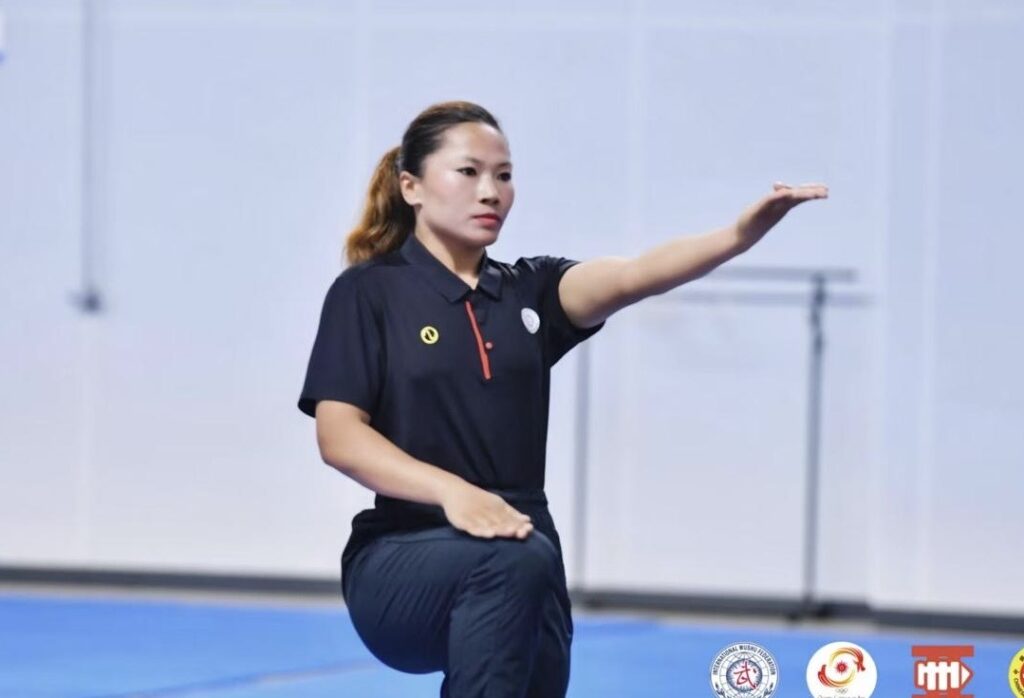
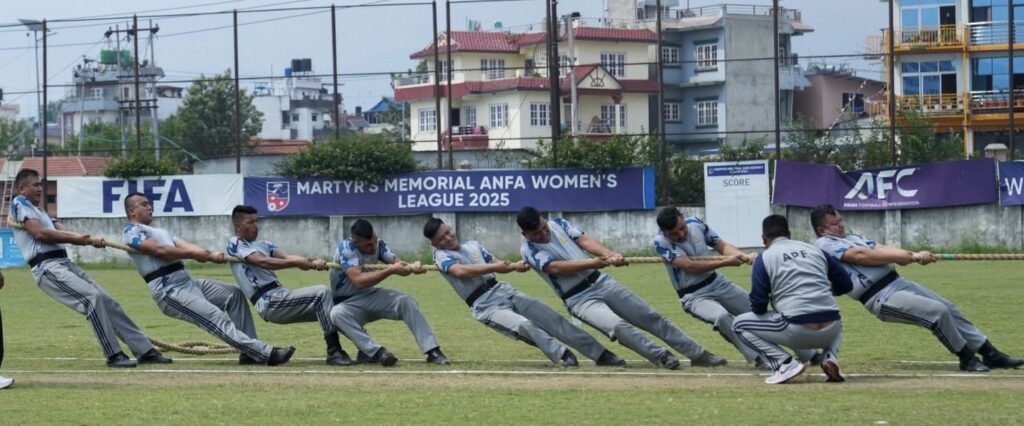
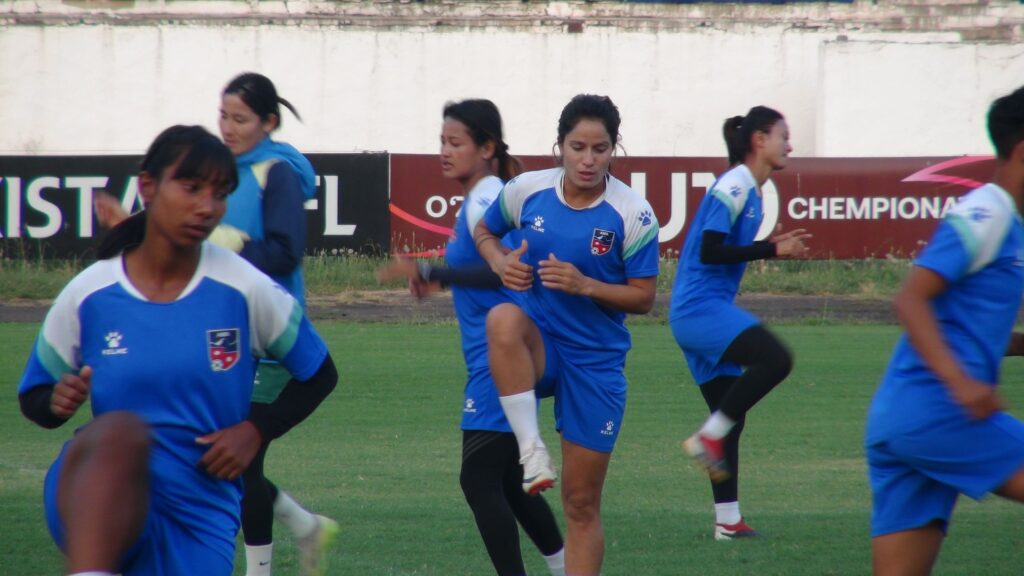
File photos of Nepal women team during their AFC Women's Asian Cup Qualifiers. Photos Courtesy: NSJF
 Prajwal Oli
 Kathmandu: Last Saturday, Nepal agonizingly saw their AFC Women’s Asian Cup dreams slip from their grasp after a heartbreaking penalty shootout defeat to Uzbekistan in a decisive Group ‘F’ qualifier match in Tashkent. But was that ambition realistic to begin with?
Was it realistic for Nepal to set an ambition for qualification at the next year’s AFC Asian Cup in Australia.
On paper, it seemed a natural step for a team that had publicly declared Mission 2027 and 2031 — bold ambitions to qualify for the FIFA Women’s World Cup within two or six years, respectively. Yet, the failure to reach the Asian Cup finals not only ends their current campaign but also slams the door shut on qualification for the 2027 World Cup.
In reality, Nepal’s women’s football team has yet to win a single major international title — not even at the sub-continental level – the SAFF Championship or the South Asian Games (SAG) football gold. In that light, the lofty goals of reaching the Asian Cup and World Cup finals seem not just overly ambitious but, frankly, elusive.
The Everest analogy: Step by step to the summit
In sports — as in life — success is built on process, structure, and gradual progress. Just as no one reaches the summit of Mount Everest without first acclimatising at the base camps, no national football team can leapfrog foundational development and expect elite-level success.
Nepal’s South Asian rivals, India and Bangladesh, offer telling examples. Both nations reached the AFC Women’s Asian Cup finals for the first time since the qualification format was introduced in 2005. India, with a record five SAFF titles, and Bangladesh, back-to-back champions in 2022 and 2024, have shown that consistent regional dominance is often a prerequisite for continental breakthroughs.
This is not to suggest that only SAFF champions can qualify for the Asian Cup. But ambition must be grounded in process — and Nepal’s process appears patchy at best.
The missing foundation: Where is the structure?
What structural groundwork has been laid in Nepal to support aspirations as grand as reaching the World Cup and Asian Cup?
Is there a stable, competitive league structure for women? Are there government or privately run women’s football academies of national standard? Are there regular youth and grassroots tournaments designed to nurture talent? Are there clear policies, development plans, or a long-term vision for women’s football?
Unfortunately, the answer to most of these questions is a resounding no.
The only exception is the Rautahat Football Academy, operated by the All Nepal Football Association (ANFA) since May 2023. The academy currently houses 30 young footballers under the guidance of AFC ‘B’ licensed coach Noor Raj Kafle — though it still lacks several basic facilities.
Aside from governmental bodies like Nepal Police, Nepal Army, and Armed Police Force, no other institutions or clubs have consistently invested in women’s football. Even prominent top-division clubs remain indifferent. For example, Sankata Club formed a women’s team for the ANFA Women’s League last year — only to dismantle it immediately afterward. Other teams often assemble makeshift squads just weeks before tournaments, only to vanish after the event ends.
Lessons from Bangladesh: A blueprint worth following
Nepal only needs to look to their South Asian neighbours for inspiration. Bangladesh, once a perennial struggle in South Asian women’s football, has made remarkable strides in just five years. A decade ago, Nepal were the main contenders in the SAFF Women’s Championship while Bangladesh were seen as underdogs.
The turning point came in 2015 when the Bangladesh Football Federation (BFF) launched a dedicated women’s youth academy. A year later, Bangladesh qualified for the AFC U-17 Women’s Championship finals by topping Group ‘C’ in the qualifiers — a breakthrough that sparked a chain of successes.
They gave continuity to the Academy and eventually won their maiden SAFF title in 2022 and defended it in 2024, defeating Nepal in both finals. Interestingly, every member of the current 23-player Bangladesh squad once came through the BFF Academy. Currently 70 footballers of different age groups are in the BFF Academy.
In contrast, Nepal have finished runners-up in six of the seven SAFF Women’s Championships but have yet to lift the trophy. The consistency in failure points not just to missed opportunities but to a deeper structural void.
A night of contrast: Dreams broken, dreams realised
As Nepal bowed out of the Asian Cup qualifiers with a 4-2 penalty defeat to Uzbekistan, both India and Bangladesh were celebrating historic qualifications. Their journeys were not built overnight but upon years of investment in youth development, infrastructure, and competitive exposure.
Nepal’s ambitions for continental and global success are commendable — but dreams, no matter how noble, must rest on the bedrock of planning, investment, and structure. Without that, they remain what they are now: dreams.

The way ahead for Nepal women’s football
On July 18, 2023, during the sponsorship signing ceremony between the Nepal Women’s Football Team and Unilever Nepal, ANFA President Pankaj Nembang announced Mission 2027 or 2031 — a vision to see Nepal play in the FIFA Women’s World Cup finals either in 2027 or 2031.
Now, with Nepal’s failure to qualify for the AFC Women’s Asian Cup, the dream of 2027 has officially collapsed.
The bigger question remains: what tangible steps has the country’s football governing body taken to realize this mission? So far, the efforts — if any — remain unclear, even mysterious.
What next for Nepal?
Should Nepal continue pursuing the 2031 World Cup dream, or is it time to recalibrate that vision? Ambitions are important — but only when backed by a clear process. Nepal needs to shift its focus toward measurable, step-by-step growth. The immediate target should be the 2025 SAFF Championship, followed by qualification for the 2029 AFC Women’s Asian Cup. The World Cup should remain the ultimate goal — but as the final milestone in a carefully laid-out journey.
To get there, Nepal must prioritise structure, planning, and professionalism. What the nation urgently needs is a combination of short-term, medium-term, and long-term strategies — all realistic, practical, and professionally crafted. These strategies must be designed by qualified experts and executed with strict oversight and accountability. Hasty, ad-hoc planning has no place in a dream as ambitious as the World Cup.
Restructuring the foundation
Nepal must not delay a comprehensive overhaul of its football development system. Grassroots talent development is the cornerstone of any successful footballing nation. Building a wider and stronger talent pool begins at the local level. In Nepal’s case, motivating schools to become active participants in grassroots football could be a highly effective approach.
Additionally, mass production of trained coaches can play a dual role — enhancing the quality of youth training and creating employment opportunities. The greater the number of technically sound coaches, the better the chances of nurturing elite players.
Rebuilding the women’s club structure
Nepal’s women’s club football desperately needs reform. The top division league should run for at least six months annually, with a fixed calendar to ensure consistency and professionalism. Teams that face repeated lopsided defeats — like 19–0 or 14–1 in the last league season — should be relegated through a proper league pyramid system, similar to the men’s ‘A’, ‘B’, and ‘C’ Divisions.
Nepal also lacks age-group tournaments for women’s football — a critical gap in the development pathway. ANFA has shown little initiative in organising these, yet such tournaments are vital. ANFA must not only take the lead but also support and encourage schools and communities in hosting age-level competitions. A good example is basketball, which has seen stability due to age-group events, mostly organised by schools in urban areas.
Moreover, top-tier men’s clubs should be encouraged or incentivised to form women’s teams, helping expand the competitive ecosystem. While some private academies are trying to fill gaps, most operate without basic equipment or trained manpower. ANFA must step in — offering technical support, equipment, and training resources generously.
A simple formula: Process first, results later
Nepal’s World Cup dream is still alive — but it cannot be pursued through wishful thinking or headline-grabbing slogans. It requires patience, discipline, structure, and a commitment to process over shortcuts.
If Nepal follows the right path, results will follow — maybe not immediately, but surely.